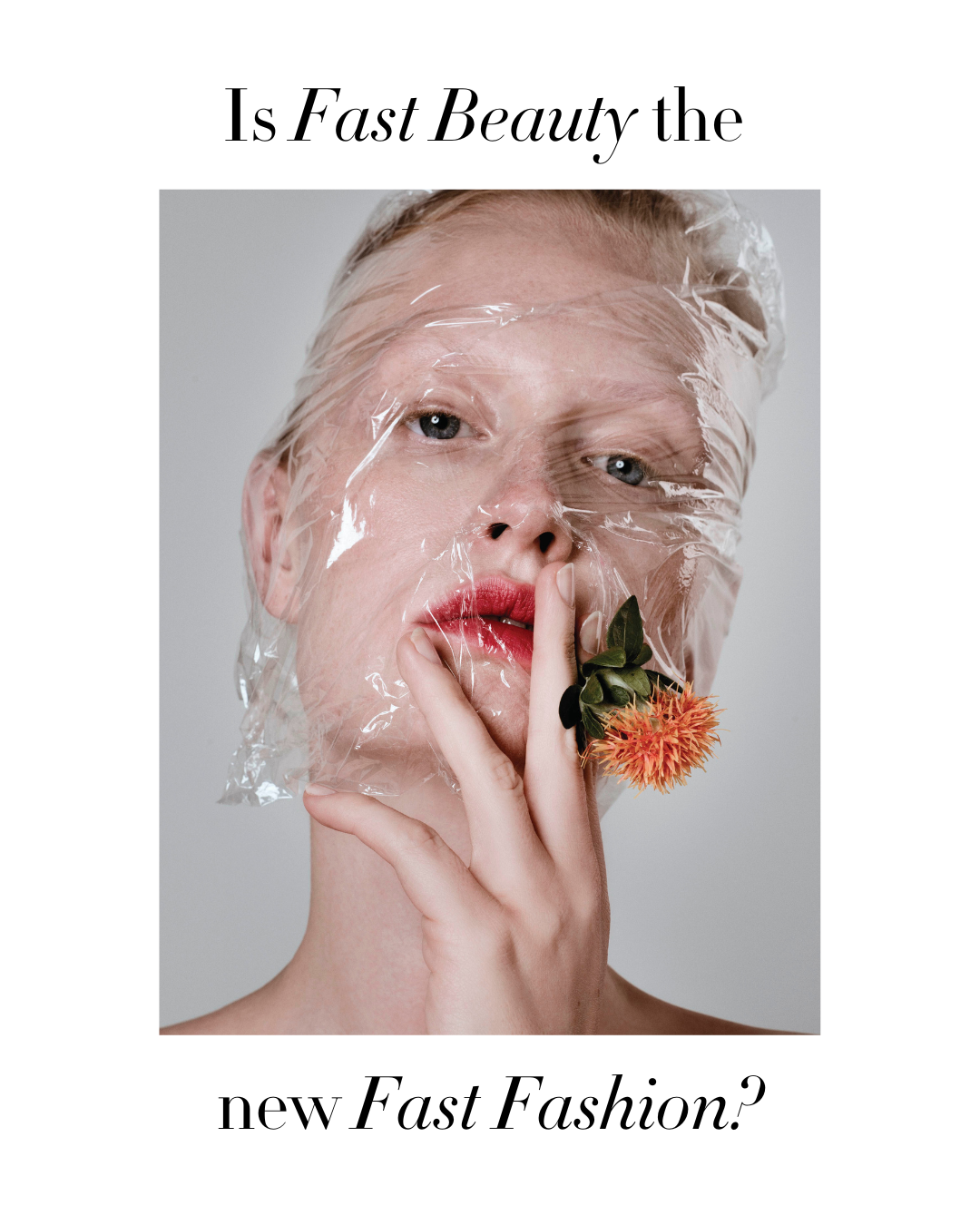
With new skincare and make-up churned out by beauty houses on a daily basis, it’s impossible to turn a blind eye to the impact the industry has on our planet.
But with the thrill of a bargain and the ‘new’ fuelling our love affair with all things beauty, Nicole Saunders asks: how do we break up with fast beauty for good?
When was the last time you finished an eyeshadow? Emptied it, sweeping each last glimmer and sparkle of colour across your lids until your eyeshadow brush scraped across the bottom of the pan. Or perhaps you’re like me: your repertoire of handbags is swelling at the seams, thanks to a glut of — and let’s be honest — barely used lipsticks, lip glosses, and lip balms.
“I can probably count on one hand how many beauty products I’ve come to the end of in the past,” says Emma Peters, founder of ethically minded beauty brand, Aleph. “It’s not a lot; you rarely get to the bottom of a jar or container,” she adds. Then, explains Peters, if you get to the bottom of the product or use as much of it as possible, comes the challenging part. “You can’t usually open it up to see if there’s any left, let alone get it out, clean it out, and then recycle it. The product is usually trapped inside, even if it is a recyclable container.” Peters says that much of the packaging and bottles inevitably end up in the landfill.
Even though the planet is bearing the brunt of our purchasing decisions, and our make-up bags and vanities are heaving with new-fangled products touted as the latest promise to ‘wrinkle-free’ skin, we keep hitting ‘add to cart’. Why do we purchase products when our skin and planet can’t keep up?
The answer isn’t simple. For a start, there are the unrealistic beauty standards — the porcelain, blemish-free, eternally youthful complexion — that many of us consciously or unconsciously buy into. Although it would be easy to posit a ‘buy less, buy better’ solution to the trend-driven beauty conundrum, it’s much more nuanced. Just as fast fashion has made certain trends and garments more accessible to the masses, fast beauty has introduced the world of make-up, skincare, and even fragrance to younger and less affluent consumers.
Then there’s the thrill: the dopamine hit of buying something new, which is intensified when we see a sale sign or a ‘bargain’ price tag — something that the fast beauty world knows all too well will tempt us. In a 2014 study published in the Journal of Consumer Psychology, researchers discovered that the phenomenon of retail therapy does, in fact, boost our moods. Not only did they find that shopping can make people happier immediately, but it can also help combat lingering sadness. In another 2014 study by the University of Michigan, researchers discovered that our shopping choices could help restore a sense of control over our personal environment and, as a result, help alleviate residual sadness.
If you’re guilty of spending hours scrolling through the ‘Sale’ section of Net-a-Porter or rummaging through the sale racks at David Jones in pursuit of an elusive bargain you don’t really need, there’s good research that shopping for a deal gives our brain a good dopamine hit, too.
In a fascinating 2007 study by Stanford, MIT, and Carnegie Mellon, researchers used MRI to examine participants’ brains as they shopped for clothes. The researchers discovered that when participants were shown objects of desire, the brain’s pleasure centre lit up. Participants were then shown the price tag, and it was found that pleasure is amplified when we think we are getting a bargain.
So, how do we quell our desire for trend-driven beauty when the yearning for a bargain appears etched into our brains? Emma Lewisham, who founded her eponymous skincare collection based on the philosophy of solving skincare problems through sustainably minded innovations, is naturally sceptical of the trend-driven beauty bandwagon. Lewisham believes the constant churn and production of beauty products creates a whole raft of problems that impact the planet and people.
“Firstly, it’s confusing the consumer. We’re overwhelming our skin with all these ingredients. Then, there’s the planet to consider because you have to think about all the packaging and waste created through the creation of fast-paced beauty.”
But with new skincare products promising to fix skin problems you never knew you had, it is hard to avoid falling under the spell of Instagrammable products offering a quick fix. “If we come back to people chasing trends around ingredients, no single product will deliver a result based on one ingredient because the skin is so much more complex,” says Lewisham, who is pioneering the way forward for sustainable yet efficacious skincare globally. She says there’s no need for brands or consumers to jump on the bandwagon.
“It’s only done for commercial reasons. The industry is jumping on them, knowing all too well that consumers get excited by new and trendy ingredients and can get really hooked by that next big thing in beauty. Everyone wants that silver bullet.”
As a consumer, I admit there have been moments I’ve found it hard to resist the alluring-yet-lofty promises of the latest must-have vitamin C serum. I assume that, as a business, when dollar signs are flashing in front of you, it must be challenging to shun buzz-worthy ingredients when your competitors are launching new products constantly. However, Lewisham resolved early in her journey to do things differently: to eschew trends and focus on creating products that solve real skincare problems. Lewisham’s skincare collection is concise and considered, and she says she genuinely doesn’t look at what competitors are doing. “We are about looking at ingredients first, understanding the skin, and creating products that solve problems.”
Both Lewisham and Peters take the lion’s share of the burden off of consumers by creating products that consider the planet and its people. However, thanks to influencer culture, chasing newness has entered a terrifying new territory. Not only are a majority of influencers afraid to be seen wearing the same outfit repeatedly, but they also don’t want to be seen hawking the same beauty routine night after night. #AD #GIFTED.
This mentality naturally trickles down to the masses, with the idea that obtaining the latest buzz product is now inextricably linked to living the ideal life according to your highlights reel – aka Instagram. As Instagram and TikTok fuel the desirability of certain products, brands now create products based on what will rack up shares and likes.
Lewisham says it doesn’t have to be the way, and an increasing number of consumers are walking away from brands that are more concerned about how they look on a social media feed than about the impact they have on the planet. She has been pleasantly surprised by the uptake of the brand refills programme. “We attract a conscious consumer, who gets a dopamine hit by knowing they’ve bought a product made of all recycled materials and can be refilled.”
Peters says brands practising only a smidgen of what they preach is frustrating and misleading for consumers. “You can be organic this or that, but as soon as you package it up in plastic, you run the risk of the plastic leaching into the product, and then the packaging goes into the landfill and eventually ends up in the earth.”
To ensure Aleph’s ethos stayed true to what Peters envisioned for the brand, she said it was vital for her to look at the bigger picture: the planet, people, animal cruelty, responsible sourcing, water-free formulations, and packaging. “I’m very hands-on with everything we do, with every ingredient choice, the formulation itself, and the packaging. I have visibility of the entire supply chain.”
Of course, Peters understands that the myriad products available with a click of the mouse are tempting for consumers. But she’s optimistic that the response to Aleph proves that you don’t need an endless array of new products to enjoy make-up. For Peters and Aleph, it’s about creating a multitude of looks with less. “In turn, you’re wasting less because you’re using that product repeatedly.”
For those mesmerised by make-up trends and having the newest lip colour in their handbag, Peters’ approach might sound a little dull or restrictive, but it’s certainly not the case; in fact, it’s the opposite.
“It’s about creating the variety and variation and getting that same excitement with a handful of products,” she explains. “Typically, you think, ‘Oh, I need something new; I need a new lip colour — and you’ll go and buy a new red lip colour or something that matches your outfit. But instead, I wanted people to be able to create that with what they’ve already got. So they’re able to mix different shades to create brand-new colours, which means that they don’t have to ditch what they’ve got and go and get something new.”
Both Peters and Lewisham are hopeful that shaking an obsession with fast beauty doesn’t have to be time-consuming, expensive, or uninspiring. “It’s about this awakening for the consumer,” says Lewisham. “It’s about realising certain products create a lot of waste and that all these products are not good for my skin.”
She says it’s common to see people loading up their skin with more and more, which ends up having the opposite of the desired effect. “That’s why we’re seeing so many people with skin barrier issues and sensitivities; it’s because of all these trends. It’s not the best way to approach skin.”
Peters says a simple place to start is by experimenting with the products you own. “A fun thing to do with a bunch of half-used lipsticks is to scrape them out and put them into a fishing tackle box. Create your own palette. And then mix colours and make up new shades,” she suggests. “It’s an excellent way to spring-clean your make-up stash.”
All of Aleph’s products are created with a similar philosophy in mind. “I’ve made them so you can use a minimal amount of product for maximum effect. Thereby, you’re using less to create more,” she explains. “But it’s also about giving the consumer many ways to work with what they already own. I’m hoping it curbs people’s appetite for racing out and buying that latest new thing because they’ll already have highly active and functional products with which they can create unique textures, tones, and shades.”
This feature first appeared in Fashion Quarterly.